 SarkariResultHome.com
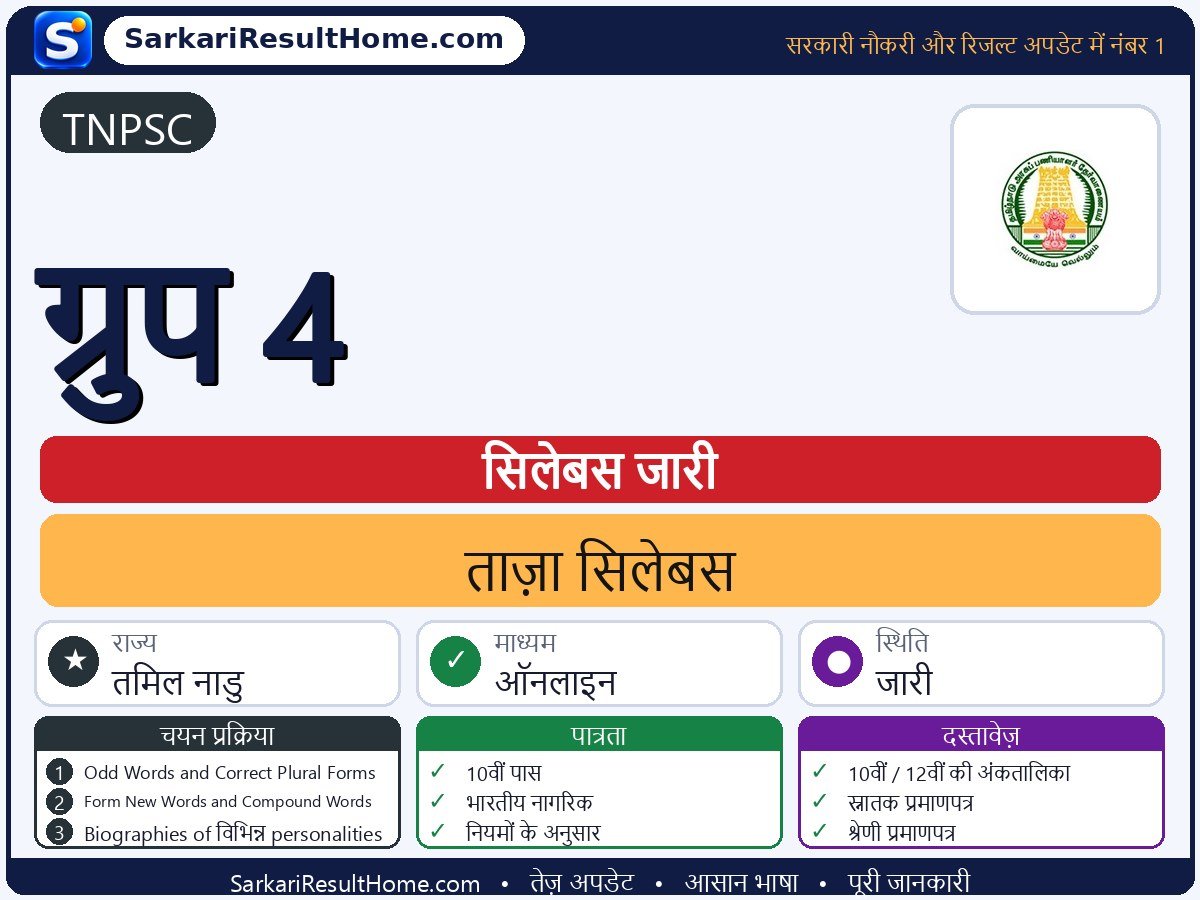
TNPSC सिलेबस 2026: Group 4 का सिलेबस और परीक्षा पैटर्न
लेखक: संदीप · 09 Oct 2026 · संस्था: Tamil Nadu Public Service Commission · राज्य: Tamil Nadu
Tamil Nadu Public Service Commission की Group 4 का सिलेबस और परीक्षा पैटर्न जारी हो गया है। तैयारी शुरू करने से पहले पूरा पैटर्न यहाँ देख लें।
सीधे लिंक इसी पेज के अंत में दिए गए हैं। कोई भी कदम उठाने से पहले आधिकारिक वेबसाइट पर जानकारी मिला लें।
TNPSC सिलेबस 2026: महत्वपूर्ण तिथियाँ
| महत्वपूर्ण तिथियाँ |
|---|
|
TNPSC सिलेबस 2026: परीक्षा पैटर्न 2026
Group 4 का परीक्षा पैटर्न तालिकाओं में नीचे है। इसे आधिकारिक अधिसूचना से मिला लें, क्योंकि संस्था इसे बदल सकती है।
संक्षेप में: नकारात्मक अंकन: नहीं।
TNPSC सिलेबस 2026: इस पेज में क्या मिलेगा
इस पेज पर Group 4 की परीक्षा का परिचय, परीक्षा पैटर्न, सिलेबस एक ही जगह दिए गए हैं, उसी क्रम में जिसमें एक विद्यार्थी को इनकी ज़रूरत पड़ती है।
- सबसे ऊपर परीक्षा का परिचय: आयोजक संस्था, स्तर, माध्यम, भाषा और अंकन
- फिर पैटर्न और विषयवार सिलेबस की तालिकाएँ, स्रोत के अनुसार सटीक अंकों और नामों के साथ
- अंत में तैयारी की योजना और अक्सर पूछे जाने वाले प्रश्न
TNPSC सिलेबस 2026: परीक्षा का परिचय
परीक्षा का माध्यम Offline (OMR-based Pen & Paper Test) है।
परीक्षा एक नज़र में - प्रश्न: 200 Questions; अंक: 300 Marks (1.5 Marks per Question); समय: 3 Hours (180 Minutes)।
नेगेटिव मार्किंग: No Negative Marking।
| विवरण | जानकारी |
|---|---|
| परीक्षा का नाम | TNPSC Group 4 |
| परीक्षा का माध्यम | Offline (OMR-based Pen & Paper Test) |
| प्रश्नों का प्रकार | Objective Type Multiple-Choice Questions (MCQs) |
| प्रश्नों की संख्या | 200 Questions |
| अंक | 300 Marks (1.5 Marks per Question) |
| समय | 3 Hours (180 Minutes) |
| नेगेटिव मार्किंग | कोई नकारात्मक अंकन नहीं |
| Recruitment Body | Tamil Nadu Public Service Commission (TNPSC) |
| Exam Level / Standard | SSLC (10th Standard) |
| Minimum Qualifying Marks | 90 Marks (30% overall; 40% mandatory in Part A) |
TNPSC सिलेबस 2026: परीक्षा पैटर्न और अंक
Group 4 के लिए परीक्षा पैटर्न और अंक इस तालिका में है।
| Parts | Subjects/Sections | No. of प्रश्न | अंक | अवधि |
|---|---|---|---|---|
| Part A | Tamil Eligibility cum Scoring Test | 100 | 150 | 3 hours (180 min) |
| Part A | General English (SSC Level) | 100 | – | 3 hours (180 min) |
| Part B | Aptitude & Mental Ability Test (SSC Level) | 25 | 150 | 3 hours (180 min) |
| Part B | General Studies | 75 | – | 3 hours (180 min) |
| कुल | 300 | 300 | 3 hours (180 min) |
TNPSC सिलेबस 2026: परीक्षा पैटर्न और अंक
नीचे की तालिका में Group 4 का विवरण स्रोत के अनुसार दिया गया है।
| Part | विषय | प्रश्न | अंक | Standard |
|---|---|---|---|---|
| A | Tamil Eligibility-cum-Scoring Test | 100 | 150 | SSLC |
| B | General Studies | 75 | 150 | SSLC |
| B | Aptitude & Mental Ability | 25 | – | SSLC |
| कुल | – | 200 | 300 | – |
TNPSC सिलेबस 2026: सबसे अधिक अंक वाले विषय
पैटर्न तालिका (TNPSC Group 4 Syllabus 2026: Exam Overview) में सबसे अधिक अंक इन पर हैं: – (300)।
अंक हर पेपर में अलग हैं, इसलिए अपने पेपर की तालिका ज़रूर देखें।
TNPSC सिलेबस 2026: अन्य विवरण
नीचे की तालिका में Group 4 का विवरण स्रोत के अनुसार दिया गया है।
| Part | विषय | Standard | प्रश्न | अंक | Language |
|---|---|---|---|---|---|
| A | Tamil Eligibility-cum-Scoring Test | SSLC | 100 | 150 | Tamil only |
| B | General Studies (6 units) | SSLC | 75 | 150 | Tamil and English |
| B | Aptitude and Mental Ability | SSLC | 25 | 150 | Tamil and English |
| Total (3 hours, OMR) | 200 | 300 |
TNPSC सिलेबस 2026: अन्य विवरण
Group 4 के लिए अन्य विवरण इस तालिका में है।
| Topics |
|---|
| Social Issues in India and Tamil Nadu |
| Evolution of 19th and 20th Century SocioPolitical movements in Tamil Nadu |
| Tamil Society (Culture and Heritage) |
| Geography of India with special reference to Tamil Nadu |
| Human Development Indicators in Tamil Nadu |
| Telangana movements for State formation |
| Role of Tamil Nadu in the freedom struggle and Role of women in the freedom struggle |
| Geography of Tamil Nadu and its impact on Economic growth |
| Education and Health systems in Tamil Nadu |
| E-governance in Tamil Nadu |
TNPSC सिलेबस 2026: अन्य विवरण
नीचे की तालिका में Group 4 का विवरण स्रोत के अनुसार दिया गया है।
| Topics |
|---|
| – Figures of Speech (Alliteration, Simile, Metaphor, etc.) |
| – Poetry Appreciation |
| – Important Lines from various poems |
| – Match the following words and phrases |
| – Choose Synonyms and Antonyms |
| – Identify Prefixes and Suffixes |
| – Fill in the blanks with suitable Articles and Prepositions |
| – Select correct Question Tags, Tense, and Voice |
| – Identify Sentence Patterns and Degrees |
| – Error Identification and Sentence Selection |
| – Odd Words and Correct Plural Forms |
| – Form New Words and Compound Words |
| – List of Prose (Various literary works by different authors) |
| – Biographies of various personalities |
| – List of Poems (Various poems by different poets) |
TNPSC सिलेबस 2026: अन्य विवरण
Group 4: अन्य विवरण नीचे तालिका में देखें।
| श्रेणी | Topics / Details |
|---|---|
| Tamil Grammar | Choosing correct words; identifying famous quotations & authors; continuing phrases & meanings; splitting words (பிரித்தெழுதுக); antonyms (எதிர்ச்சொல்); identifying inappropriate/incorrect words; correcting spelling, singular/plural & grammatical errors; Tamil equivalents of English words; sound variations & meanings; meaning of one-letter words; root words (வேர்ச்சொல்); forming verb forms, verbal nouns & occupational nouns; alphabetical ordering; arranging words into sentences; types of nouns; grammatical notes; choosing questions for answers; types of sentences; active, causative & passive sentences; meanings through similes; Ethukai, Monai, Iyaibu; proverbs (பழமொழிகள்) |
| Thirukkural (25 Chapters) | Anbu, Panbu, Kalvi, Kelvi, Arivu, Adakkam, Ozhukkam, Porai, Natpu, Vaimai, Kalam, Vali, Oppuravarithal, Seynandri, Sanrananmai, Periyarai Thunaik Kolal, Porul Seyal Vagai, Vinai Thittam, Iniyavai Kural, Ookka Mudaiyai, Eegai, Therindhu Seyal Vagai, Inna Seyyamai, Kooda Nattri, Uzhavu |
| Aram Noolgal | Naladiyar, Nanmanikadigai, Pazhamozhi Naanuru, Muthumozhi Kanchi, Thirikadugam, Inna Narpathu, Iniyavai Narpathu, Sirupanchamoolam, Elathi, Avvaiyar’s works, other Pathinen Keezhkanakku works |
| Epic & Classical Literature | Kamba Ramayanam, Ravana Kaviyam, Purananuru, Agananuru, Natrinai, Kurunthogai, Aingurunuru, Kalithogai, Ettuthogai, Pathupattu, Silappathikaram, Manimekalai, Jain & Buddhist epics |
| Bhakti & Other Literary Works | Periyapuranam, Nalayira Divya Prabandham, Thiruvilaiyadal Puranam, Thembavani, Seerapuranam |
| Minor Literary Works (Chitrilakkiyangal) | Thirukkutralakuravanji, Kalingathuparani, Muthollayiram, Tamilvidu Thoothu, Nandhikkalambagam, Mukkoodarpallu, Kavadi Chindu, Muthukumaraswamy Pillai Thamizh, Rajaraja Soman Ula |
| Other Literary Works | Manonmaniyam, Panchali Sabatham, Kuyil Pattu, Iratturai Mozhithal, Azhagiya Chokkanathar, Folk songs, Siddhar songs |
| Tamil Scholars & Religious Pioneers | Appar, Sambandhar, Sundarar, Manickavasagar, Thirumoolar, Kulasekara Azhwar, Andal, Seethalai Sathanar, H.A. Krishnanar, Umaruppuvar |
| Modern Poets & Writers | Bharathiyar, Bharathidasan, Namakkal Kavignar, Kavimani Desiga Vinayagam, Mudiyarasan, Vanidasan, Suratha, Kannadasan, Udumalai Narayana Kavi, Pattukkottai Kalyanasundaram, Marudhakasi |
| New Poetry (Puthukavithai) | N. Pichamurthy, C.S. Chellappa, Dharumu Sivaramu, Pasuvayya, Ra. Meenakshi, C. Mani, Sirpi, Mu. Metha, Erode Thamizhan, Abdul Rahman, Kalapriya, Kalyanji, Gnanakkoothan |
| Tamil Epistolary Literature | Diaries, Jawaharlal Nehru, Mahatma Gandhi, Mu. Varadarasanar, Perarignar Anna |
| Short Stories & Fine Arts | Tamil short stories & authors; matching authors with works; folk & performing arts; sculpture; painting; public speaking; cinema |
| Antiquity & Development of Tamil | Antiquity of Tamil language; special features of Tamil; Dravidian languages; development of Tamil; scientific ideas & thoughts in Tamil |
| Tamil Prose & Language Service | Maraimalai Adigal, Parithimar Kalaignar, N.M. Venkatasamy Naattar, Ra.Pi. Sethu, Thiru.Vi. Kalyanasundaranar, Vaiyapuri, Prof. Thaninayagam Adigal, Sekkuthambi Pavalar, U.Ve. Swaminathar, The. Po. Meenakshi Sundaranar, C. Ilakkuvanar, Devaneya Pavanar, Pavalar Perunchithiranar, G.U. Pope, Veeramamunivar |
| Social Reformers & Tamil Nadu Personalities | Thanthai Periyar, Perarignar Anna, Muthuramalingar, B.R. Ambedkar, Kamarajar, Ma.Po. Sivagnanam, Kayidhe Millath |
| Tamil Nadu & Global Tamil Community | Origin & changes of place names; global Tamil contributions; Tamil language & cultural heritage; Tamil trade & archaeological studies; ancient sea voyages; palm-leaf manuscripts; food as medicine & medicinal herbs; religious harmony; Thayumanavar, Ramalinga Adigalar, Thiru.Vi. Kalyanasundaranar |
| Women in Tamil History & Society | Mooloor Ramamirthammal, Dr. Muthulakshmi Ammaiyar, Velu Nachiyar, Thillaiyadi Valliammai, Rani Mangammal, Annie Besant; role of women in freedom struggle; contributions to Tamil society |
TNPSC सिलेबस 2026: अन्य विवरण
Group 4 के लिए अन्य विवरण इस तालिका में है।
| Topics |
|---|
| Simplification |
| Percentage |
| Problems on H.C.F & L.C.M |
| Simple Interest And Compound Interest |
| Ratio and Proportion |
| Volume |
| Logical Reasoning |
| Area |
| Puzzles |
| Dice |
| Visual Reasoning |
| Alpha Numeric Reasoning |
| Number Series |
| Time and Work |
TNPSC सिलेबस 2026: अन्य विवरण
Group 4 के लिए अन्य विवरण इस तालिका में है।
| श्रेणी | Topics / Details |
|---|---|
| 1. General Science | Nature of Universe, Measurement, Scientific Laws in Motion, Force, Pressure, Energy; Everyday applications of Mechanics, Electricity, Magnetism, Light, Sound, Heat, Nuclear Physics; Elements, Compounds, Acids, Bases, Salts, Petroleum Products, Fertilizers, Pesticides, Metallurgy, Food Adulterants; Life Science concepts, Classification, Evolution, Genetics, Physiology, Nutrition, Health & Hygiene, Human diseases; Environmental Science |
| 2. Current Events | Latest events, National symbols, State profiles, Eminent personalities, Places in news, Sports, Books & Authors; Government welfare schemes, Political parties & systems in Tamil Nadu and India; Latest inventions in Science & Technology, Geographical landmarks, Current socio-economic issues |
| 3. Geography | Earth location, Physical features, Monsoon, Rainfall, Weather & Climate, Water resources, Rivers, Soil, Minerals, Natural resources, Forest & Wildlife, Agriculture; Transport, Communication; Population density & distribution in Tamil Nadu and India; Calamities, Disaster Management, Environment, Climate change |
| 4. History and Culture of India | Indus Valley Civilization, Guptas, Delhi Sultans, Mughals, Marathas, South Indian History; Characteristics of Indian Culture, Unity in Diversity – Race, Language, Custom; India as a Secular State |
| 5. Indian Polity | Constitution of India, Preamble, Salient features, Union, State & Union Territory; Citizenship, Fundamental Rights, Fundamental Duties, Directive Principles; Union Executive, Union Legislature, State Executive, State Legislature, Local Governments, Panchayat Raj; Federalism: Centre-State relationships; Election, Judiciary, Rule of Law; Corruption, Anti-Corruption measures, Lokpal & Lokayukta, RTI, Women Empowerment, Consumer Protection, Human Rights |
| 6. Indian Economy | Nature of Indian economy, Five Year Plans, Planning Commission & NITI Aayog; Sources of revenue, RBI, Finance Commission, Resource sharing, GST; Economic trends, Employment, Land Reforms, Agriculture, Science & Technology in Agriculture, Industrial growth, Rural welfare programmes, Social problems, Population, Education, Health, Employment, Poverty |
| 7. Indian National Movement | National Renaissance, Early uprisings against British Rule, Indian National Congress; Emergence of leaders: B.R. Ambedkar, Bhagat Singh, Bharathiar, V.O. Chidambaranar, Thanthai Periyar, Jawaharlal Nehru, Rabindranath Tagore, Kamarajar, Mahatma Gandhi, Maulana Abul Kalam Azad, Rajaji, Subhash Chandra Bose, Muthulakshmi Ammaiyar, Muvalur Ramamirtham, and others; Different modes of agitation in Tamil Nadu and movements |
| 8. History, Culture, Heritage and Socio-Political Movements of Tamil Nadu | History of Tamil Society, Archaeological Discoveries, Tamil Literature from Sangam age to contemporary times; Thirukkural: Secular literature, Relevance to everyday life, Impact on humanity, Universal values, Socio-politico-economic relevance, Philosophical content; Role of Tamil Nadu in freedom struggle, Early agitations, Role of women; Social reformers, Social reform movements, Social transformation |
| 9. Development Administration in Tamil Nadu | Social Justice & Social Harmony as cornerstones of socio-economic development; Education & Health systems in Tamil Nadu; Geography of Tamil Nadu & its impact on Economic growth |
| 10. Aptitude & Mental Ability Tests | Simplification, Percentage, HCF, LCM; Ratio & Proportion; Simple Interest, Compound Interest, Area, Volume, Time & Work; Logical Reasoning, Puzzles, Dice, Visual Reasoning, Alpha Numeric Reasoning, Number Series |
TNPSC सिलेबस 2026: अन्य विवरण
Group 4: अन्य विवरण नीचे तालिका में देखें।
| Topics |
|---|
| – Latest diary of events |
| – National symbols |
| – Profile of states |
| – Eminent personalities and places in the news |
| – Sports |
| – Books and Authors |
| – Political parties and Political systems in Tamil Nadu and India |
| – Nature of Universe |
| – Measurement of Physical Quantities |
| – General Scientific Laws |
| – Everyday application of basic principles |
| – Location |
| – Physical features |
| – Water resources |
| – Agricultural patterns |
| – Rivers in India |
| – Monsoon |
| – Rainfall |
| – Weather and climate |
| – Forest and wildlife |
| – Soil, minerals, and natural resources |
| – Nature of Indian economy |
| – Five-year plan models |
| – Sources of revenue |
| – Economic Trends |
| – Geography of Tamil Nadu |
| – Indus Valley civilization |
| – Characteristics of Indian culture |
| – Change and Continuity in the SocioCultural History of India |
| – History, Culture, and SocioPolitical Movement in Tamil Nadu |
| – National renaissance |
| – Indian National Congress |
| – Early uprising against British rule |
| – Emergence of leaders |
| – Different Modes of Agitation |
TNPSC सिलेबस 2026: अन्य विवरण
नीचे की तालिका में Group 4 का विवरण स्रोत के अनुसार दिया गया है।
| Timeline | Primary Focus | Key Tasks |
|---|---|---|
| Days 1–30 | Concept Building | • Complete Tamil Grammar rules & Thirukkural chapters.; • Cover Aptitude formulas & basic concepts.; • Read (TN State Board) 6th–10th books for General Studies. |
| Days 31–60 | Topic Practice & PYQs | • Solve Tamil Nadu History (Unit 8) & Polity questions daily.; • Solve Previous Year Question papers to identify high-weightage topics.; • Practice 25 Aptitude questions daily for speed. |
| Days 61–90 | Mock Tests & Revision | • Take full-length 3-hour OMR mock tests.; • Revise short notes, current affairs, and weak areas.; • Avoid starting new topics in the final two weeks. |
TNPSC सिलेबस 2026: अन्य विवरण
Group 4 के लिए अन्य विवरण इस तालिका में है।
| Also Check |
|---|
| TNPSC Group 4 Salary |
| TNPSC Group 4 Previous Year Papers |
| TNPSC Group 4 Exam Date 2026 |
TNPSC सिलेबस 2026: इस सिलेबस का उपयोग कैसे करें
- सबसे पहले ऊपर दिया गया परीक्षा का परिचय पढ़ें, ताकि आपको आयोजक संस्था, माध्यम, भाषा और अंकन का सही अंदाज़ा हो।
- इस पेज पर एक से अधिक पैटर्न तालिकाएँ हैं (पेपर या पद के अनुसार); पहले वही तालिका पढ़ें जो आपके पद या पेपर से मेल खाती है।
- नेगेटिव मार्किंग: No Negative Marking। इसलिए सभी प्रश्न हल करने का प्रयास करें।
- विषयवार टॉपिक अपनी कॉपी या शीट में उतार लें और हर टॉपिक के आगे पढ़ा, दोहराया और टेस्ट किया का निशान लगाएँ।
TNPSC सिलेबस 2026: तैयारी की योजना, चरण दर चरण
- परीक्षा का परिचय और पैटर्न की तालिका ध्यान से पढ़ें और ज़रूरी बातें नोट करें।
- विषयवार सिलेबस से टॉपिक की चेकलिस्ट बनाएँ।
- जिन विषयों के अंक अधिक हैं, उन्हें पढ़ाई में पहले और ज़्यादा समय दें।
- हर हफ्ते पुराने प्रश्नपत्र हल करें और गलतियों की कॉपी बनाएँ।
- मॉक टेस्ट परीक्षा के समय (3 Hours (180 Minutes)) में ही पूरा करने की आदत डालें।
- हर महीने आधिकारिक सूचना खोलकर देखें कि सिलेबस या पैटर्न में बदलाव तो नहीं हुआ।
TNPSC की पिछली अधिसूचनाएँ
तुलना के लिए TNPSC की पिछली अधिसूचनाएँ नीचे हैं। किसी भी शीर्षक पर क्लिक करें, या देखें: TNPSC के सभी अपडेट।
| अपडेट | प्रकार | पद | मुख्य तिथि |
|---|---|---|---|
| TNPSC एडमिट कार्ड 2026: Group 2 परीक्षा का एडमिट कार्ड डाउनलोड करें | एडमिट कार्ड | — | — |
| TNPSC Group 2 Mains Answer Key 2026 Released | आंसर की | — | 29 Jun 2026 |
| TNPSC सिलेबस 2026: Group 2 Complete Guide का सिलेबस और परीक्षा पैटर्न | सिलेबस | — | — |
| TNPSC सिलेबस 2026: Group 1 Prelims Mains का सिलेबस और परीक्षा पैटर्न | सिलेबस | — | — |
| TNPSC सिलेबस 2026: CTS Updated Subject-Wise का सिलेबस और परीक्षा पैट | सिलेबस | — | 05 Nov 2026 |
| TNPSC सिलेबस 2026: Assistant Agricultural Officer (AAO) का सिलेबस और | सिलेबस | — | 05 Nov 2026 |
महत्वपूर्ण लिंक
| लिंक | खोलें |
|---|---|
| आधिकारिक सिलेबस — TNPSC Group IV Syllabus 2026 | यहाँ क्लिक करें |
| आधिकारिक वेबसाइट | tnpsc.gov.in |
| TNPSC के सभी अपडेट | TNPSC भर्ती खोलें |
| TNPSC की ताज़ा नौकरियाँ | नौकरियाँ देखें |
| TNPSC के एडमिट कार्ड | एडमिट कार्ड देखें |
| TNPSC के रिजल्ट | रिजल्ट देखें |
अक्सर पूछे जाने वाले प्रश्न (FAQ)
Group 4 परीक्षा किस माध्यम से होती है?
परीक्षा का माध्यम Offline (OMR-based Pen & Paper Test) है।
Group 4 परीक्षा का समय कितना है?
परीक्षा का समय 3 Hours (180 Minutes) है।
क्या Group 4 में नेगेटिव मार्किंग है?
नेगेटिव मार्किंग: No Negative Marking।
Group 4 में कुल कितने प्रश्न होते हैं?
प्रश्नों की संख्या: 200 Questions।
Group 4 परीक्षा कितने अंकों की होती है?
अंक: 300 Marks (1.5 Marks per Question)।
TNPSC Group 4 का आधिकारिक सिलेबस या सूचना कहाँ से डाउनलोड करें?
इसी पेज की महत्वपूर्ण लिंक तालिका में आधिकारिक लिंक दिया गया है या TNPSC की वेबसाइट खोलें। कोई अंतर होने पर आधिकारिक दस्तावेज़ ही मान्य है।
क्या TNPSC Group 4 का सिलेबस या पैटर्न बदल सकता है?
हाँ। आयोजक संस्था नई अधिसूचना में सिलेबस या पैटर्न बदल सकती है, इसलिए तैयारी शुरू करने से पहले और परीक्षा से पहले आधिकारिक सूचना ज़रूर देखें।
सरकारी नौकरी, रिजल्ट और एडमिट कार्ड की ताज़ा जानकारी कहाँ मिलेगी?
SarkariResultHome.com पर हर नई भर्ती, एडमिट कार्ड, रिजल्ट और आंसर की की जानकारी प्रकाशित होते ही मिल जाती है। साइट को बुकमार्क कर लें।
स्रोत और श्रेय
इस पेज की जानकारी Tamil Nadu Public Service Commission द्वारा जारी आधिकारिक अधिसूचना से ली गई है और हमारे अपने शब्दों में लिखी गई है। संस्था की आधिकारिक वेबसाइट: tnpsc.gov.in।
SarkariResultHome.com पर पढ़ने के लिए धन्यवाद। यह जानकारी काम आई हो तो sarkariresulthome.com याद रखें और नई भर्ती या रिजल्ट के लिए फिर आएँ।
श्रेणी के अनुसार और सरकारी नौकरियाँ देखें
संस्था (Company)
शिक्षा (Education)
राज्य (State)
और देखें
SarkariResultHome.com के बारे में
SarkariResultHome.com एक निःशुल्क वेबसाइट है, जो देश भर के विद्यार्थियों और नौकरी चाहने वालों के लिए सरकारी भर्ती, एडमिट कार्ड, रिजल्ट, आंसर की, सिलेबस और एडमिशन की खबरें एक जगह लाती है। हर जानकारी आधिकारिक अधिसूचना पढ़कर अपने शब्दों में लिखी जाती है, जिसमें महत्वपूर्ण तिथियाँ, आवेदन शुल्क, आयु सीमा, पदों की संख्या और आधिकारिक वेबसाइट के सीधे लिंक सरल हिंदी में दिए जाते हैं, ताकि आप समय बचाकर भरोसे के साथ आवेदन कर सकें।
अस्वीकरण (Disclaimer)
SarkariResultHome.com एक सरकारी वेबसाइट नहीं है और किसी सरकारी विभाग, बोर्ड या भर्ती संस्था से जुड़ी नहीं है। हम हर जानकारी सही रखने की पूरी कोशिश करते हैं, फिर भी गलती हो सकती है। आवेदन करने या कोई शुल्क देने से पहले कृपया संस्था की अपनी आधिकारिक वेबसाइट पर अधिसूचना पढ़ें। इस पेज की जानकारी के उपयोग से हुए किसी नुकसान की जिम्मेदारी हमारी नहीं है। हम नौकरी के लिए कभी पैसे नहीं लेते, इसलिए पैसे माँगने वाले किसी व्यक्ति पर भरोसा न करें।
SarkariResultHome.com एक स्वतंत्र सूचना वेबसाइट है। अधिसूचनाएँ, नाम और लोगो संबंधित संस्थाओं के हैं।