 SarkariResultHome.com
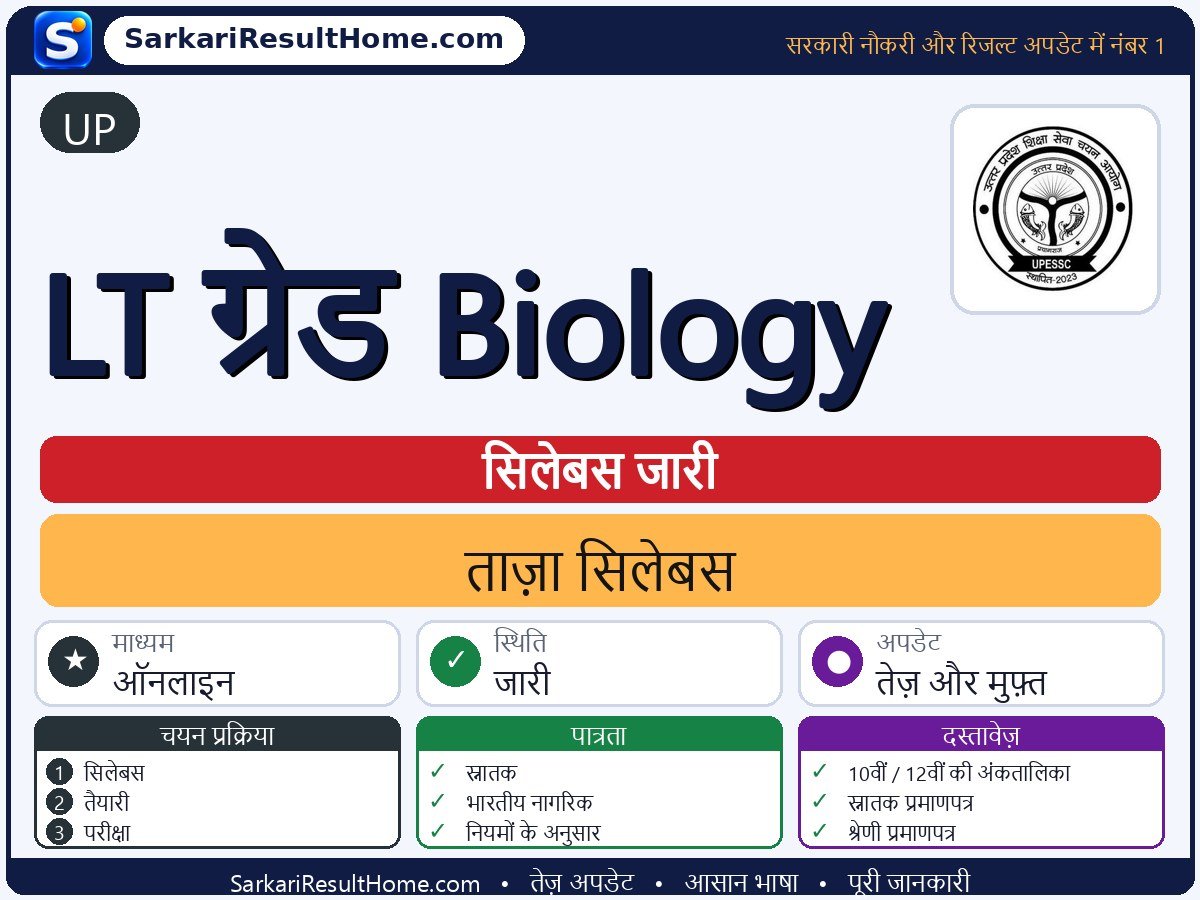
UP सिलेबस 2026: LT Grade Biology का सिलेबस और परीक्षा पैटर्न
लेखक: केतन · 17 Oct 2026 · संस्था: UP
UP LT Grade Biology के लिए सिलेबस उपलब्ध है। नीचे महत्वपूर्ण तिथियाँ और आधिकारिक लिंक दिए गए हैं।
सभी आधिकारिक लिंक नीचे “महत्वपूर्ण लिंक” तालिका में दिए गए हैं। आवेदन या डाउनलोड से पहले आधिकारिक अधिसूचना जरूर पढ़ें।
UP सिलेबस 2026: महत्वपूर्ण तिथियाँ
| महत्वपूर्ण तिथियाँ |
|---|
|
UP सिलेबस 2026: परीक्षा पैटर्न 2026
पढ़ाई शुरू करने से पहले LT Grade जीव विज्ञान का पैटर्न देख लें: चरण, विषय, अंक और हर भाग का समय। इसी से तय होगा कि आप अपने घंटे कैसे बाँटें।
संक्षेप में: नकारात्मक अंकन: नहीं।
UP सिलेबस 2026: सिलेबस 2026 (विषय-वार टॉपिक)
LT Grade जीव विज्ञान के विषय-वार टॉपिक: ऊपर के पैटर्न में जिस विषय के अंक सबसे ज्यादा हैं, वहीं से शुरू करें।
| विषय | टॉपिक |
|---|---|
| UP LT Grade Biology | Classification और features of phyla:, Annelida, Arthropoda, Mollusca, Echinodermata, Chordata, Protozoa: Entamoeba, Euglena, Plasmodium, Paramecium, Porifera: Leucosolenia, Sycon, Cnidaria: Hydra, Aurelia, Obelia, Ctenophora: Pleurobrachia, Platyhelminthes: Fasciola, Taenia, Aschelminthes: Ascaris, Annelida: Nereis, Pheretima, Hirudinaria, Arthropoda: Cockroach, Musca, Mosquito, Prawn, Mollusca: Unio, Pila, Echinodermata: Starfish, Protozoan और helminth diseases, Polymorphism in cnidarians, Harmful और beneficial insects, Poisonous vs non-poisonous snakes, Economic importance of mammals, Prokaryotic vs eukaryotic cells, Cell organelles, chromosomes, gene structure, Mitosis और meiosis, Mendel’s laws, linkage, crossing over, Mutation, gene interaction, eugenics, DNA replication, genetic code, gene expression, and regulation, Organic evolution और theories (Lamarckism, Darwinism, Neo-Darwinism), Human evolution, Biogeography, zoogeographical realms, Components of the ecosystem, pollution, and ecological balance, Digestion, respiration, circulation, excretion, Nerve conduction, muscle contraction, Endocrine glands और functions |
UP सिलेबस 2026: इस पेज में क्या मिलेगा
इस पेज पर LT Grade जीव विज्ञान की परीक्षा का परिचय, परीक्षा पैटर्न, सिलेबस, टॉपिक सूची एक ही जगह दिए गए हैं, उसी क्रम में जिसमें एक विद्यार्थी को इनकी ज़रूरत पड़ती है।
- सबसे ऊपर परीक्षा का परिचय: आयोजक संस्था, स्तर, माध्यम, भाषा और अंकन
- फिर पैटर्न और विषयवार सिलेबस की तालिकाएँ, स्रोत के अनुसार सटीक अंकों और नामों के साथ
- अंत में तैयारी की योजना और अक्सर पूछे जाने वाले प्रश्न
UP सिलेबस 2026: सिलेबस के टॉपिक
LT Grade जीव विज्ञान के लिए इन बातों का ध्यान रखें।
- Identify high-scoring topics
- Plan revision schedules effectively
- Avoid unnecessary topics
- Build confidence with targeted preparation
UP सिलेबस 2026: परीक्षा का परिचय
परीक्षा एक नज़र में - प्रश्न: 150 (30 General Studies + 120 Main/Optional Subject); अंक: 300 (Each question carries 2 marks); समय: 2 hours।
नेगेटिव मार्किंग: Yes, 0.33 marks are deducted for each wrong answer.।
| विवरण | जानकारी |
|---|---|
| प्रश्नों की संख्या | 150 (30 General Studies + 120 Main/Optional Subject) |
| अंक | 300 (Each question carries 2 marks) |
| समय | 2 hours |
| नेगेटिव मार्किंग | Yes, 0.33 marks are deducted for each wrong answer. |
| Question Paper | One (Objective Type) |
| Optional Subject | Biology |
| Qualifying Marks | 35% for SC/ST and 40% for others |
UP सिलेबस 2026: परीक्षा पैटर्न और अंक
LT Grade जीव विज्ञान के लिए परीक्षा पैटर्न और अंक इस तालिका में है।
| Eligibility | Only candidates who qualify for the Preliminary Exam |
|---|---|
| Question Paper | One (Descriptive/Conventional Type) |
| Total Questions | 20 Questions (Divided into 2 sections) |
| Section A | 10 Short Answer Questions (125 words each, 8 marks each) = 80 marks |
| Section B | 10 Long Answer Questions (200 words each, 12 marks each) = 120 marks |
| Total Marks | 200 |
| अवधि | 3 hours |
| Compulsory Questions | All questions are mandatory |
| Qualifying Marks | 35% for SC/ST and 40% for others |
UP सिलेबस 2026: अन्य विवरण
LT Grade जीव विज्ञान: अन्य विवरण नीचे तालिका में देखें।
| Classification & सामान्य Characteristics | Principles of taxonomy, species and subspecies concepts, binomial nomenclature; Classification and features of phyla:; Protozoa, Porifera, Cnidaria, Ctenophora, Platyhelminthes, Aschelminthes; Annelida, Arthropoda, Mollusca, Echinodermata, Chordata |
|---|---|
| Representative Organisms & Life Cycles | Protozoa: Entamoeba, Euglena, Plasmodium, Paramecium; Porifera: Leucosolenia, Sycon; Cnidaria: Hydra, Aurelia, Obelia; Ctenophora: Pleurobrachia; Platyhelminthes: Fasciola, Taenia; Aschelminthes: Ascaris; Annelida: Nereis, Pheretima, Hirudinaria; Arthropoda: Cockroach, Musca, Mosquito, Prawn; Mollusca: Unio, Pila; Echinodermata: Starfish; Chordata: Herdmania, Amphioxus, Scoliodon, Rana, Uromastix, Columba, Rabbit |
| Applied Zoology Topics | Protozoan and helminth diseases; Polymorphism in cnidarians; Harmful and beneficial insects; Poisonous vs non-poisonous snakes; Economic importance of mammals |
| Cell Biology & Genetics | Prokaryotic vs eukaryotic cells; Cell organelles, chromosomes, gene structure; Mitosis and meiosis; Mendel’s laws, linkage, crossing over; Mutation, gene interaction, eugenics; DNA replication, genetic code, gene expression, and regulation |
| Evolution & Ecology | Organic evolution and theories (Lamarckism, Darwinism, Neo-Darwinism); Human evolution; Biogeography, zoogeographical realms; Components of the ecosystem, pollution, and ecological balance |
| Human Physiology (Basic Knowledge) | Digestion, respiration, circulation, excretion; Nerve conduction, muscle contraction; Endocrine glands and functions |
| Biochemistry | Classification and function of carbohydrates, proteins, lipids, enzymes, and hormones |
| Embryology | Gametogenesis, types of eggs, cleavage; Embryonic development: Amphioxus, Frog, Chick; Mammalian placenta |
UP सिलेबस 2026: अन्य विवरण
LT Grade जीव विज्ञान के लिए अन्य विवरण इस तालिका में है।
| Microbiology & Lower Plants | Viruses: Structure (TMV, bacteriophage), transmission, economic importance; Bacteria: Cell structure, nutrition, reproduction, significance; Fungi: Classification (Alexopoulos & Mims), life cycles – Rhizopus, Albugo, Aspergillus, Agaricus, Puccinia, Ustilago, Alternaria; Algae: Classification, pigments, life cycles – Chlamydomonas, Volvox, Oedogonium, Vaucheria, Chara, Ectocarpus, Polysiphonia, Cyanobacteria; Lichens: Nature, structure, types, economic role; Bryophytes: Life cycles – Riccia, Marchantia, Anthoceros, Funaria; Pteridophytes: Structure, classification, Lycopodium, Selaginella, Marsilea, heterospory and seed habit; Gymnosperms: Cycas, Pinus, Ephedra – structure, classification, life cycle; Paleobotany: Fossil types, fossilization, Rhynia, geological time scale |
|---|---|
| Taxonomy of Angiosperms | Binomial nomenclature; Bentham & Hooker’s classification; Key plant families: Ranunculaceae, Fabaceae, Solanaceae, Lamiaceae, Poaceae, etc.; Botanical gardens and herbaria |
| Anatomy | Plant tissues and tissue systems; Anomalous secondary growth; Anatomy of root, stem: Tinospora, Dracaena, Bignonia, Boerhavia, Nyctanthes |
| Economic Botany | Medicinal plants, spices, condiments, oil-yielding plants; Timber, fiber crops, beverage-yielding plants |
| Embryology | Structure of anther and ovule; Microsporogenesis and megasporogenesis; Pollination, fertilization, endosperm, embryo development; Parthenocarpy, apomixis, polyembryony |
| Cytogenetics | Cell division, cell organelles; Chromosome structure and aberrations; Mendelian genetics, gene interaction; Mutation, polyploidy |
| Plant Physiology | Water absorption, transpiration, ascent of sap; Photosynthesis, respiration; Phytohormones, seed germination, dormancy; Mineral nutrition and deficiency; Photoperiodism, vernalization, nitrogen cycle |
| Biochemistry | Structure and role of carbohydrates, proteins, lipids, nucleic acids, and enzymes |
| Ecology & Environment | Environmental factors, adaptations; Soil conservation, biodiversity; Ecosystem, ecological pyramids, food chain/web; In-situ and ex-situ conservation; Plant succession and pollution |
| Plant Pathology | Symptoms and control of major diseases:; Late/early blight of potato, rust of wheat, citrus canker, mosaic of bhindi; Methods of disease control (bacterial, fungal, viral) |
| Molecular Biology & Biotechnology | Genetic engineering and its role in agriculture; Recombinant DNA tech, transgenic plants; Tissue culture, biofertilizers, biopesticides; Gene concept, structure, replication, expression |
UP सिलेबस 2026: इस सिलेबस का उपयोग कैसे करें
- सबसे पहले ऊपर दिया गया परीक्षा का परिचय पढ़ें, ताकि आपको आयोजक संस्था, माध्यम, भाषा और अंकन का सही अंदाज़ा हो।
- नेगेटिव मार्किंग: Yes, 0.33 marks are deducted for each wrong answer.। इसलिए अंदाज़े से उत्तर न दें और केवल पक्के उत्तर चिह्नित करें।
- विषयवार टॉपिक अपनी कॉपी या शीट में उतार लें और हर टॉपिक के आगे पढ़ा, दोहराया और टेस्ट किया का निशान लगाएँ।
UP सिलेबस 2026: तैयारी की योजना, चरण दर चरण
- परीक्षा का परिचय और पैटर्न की तालिका ध्यान से पढ़ें और ज़रूरी बातें नोट करें।
- विषयवार सिलेबस से टॉपिक की चेकलिस्ट बनाएँ।
- हर हफ्ते पुराने प्रश्नपत्र हल करें और गलतियों की कॉपी बनाएँ।
- मॉक टेस्ट परीक्षा के समय (2 hours) में ही पूरा करने की आदत डालें।
- हर महीने आधिकारिक सूचना खोलकर देखें कि सिलेबस या पैटर्न में बदलाव तो नहीं हुआ।
UP की पिछली अधिसूचनाएँ
तुलना के लिए UP की पिछली अधिसूचनाएँ नीचे हैं। किसी भी शीर्षक पर क्लिक करें, या देखें: UP के सभी अपडेट।
| अपडेट | प्रकार | पद | मुख्य तिथि |
|---|---|---|---|
| UP Government Job 2026 for 11 Budaun ECCE Educator Posts – Download PDF | सरकारी नौकरी | 11 | 29 Oct 2026 |
| UP भर्ती 2026: 100 पदों पर आवेदन | सरकारी नौकरी | 100 | 30 Oct 2026 |
| UP भर्ती 2026: ECCE Educator Fatehpur के 140 पदों के लिए आवेदन करें | सरकारी नौकरी | 140 | 07 Nov 2026 |
| UP Government Job 2026 for 1 Jhansi ECCE Educator Post – Download Now | सरकारी नौकरी | 1 | 22 Oct 2026 |
| UP भर्ती 2026: Hapur ECCE Educator के 58 पदों के लिए आवेदन करें | सरकारी नौकरी | 58 | 23 Oct 2026 |
| UP सिलेबस 2026: LT Grade Teacher Prelims Mains का सिलेबस और परीक्षा | सिलेबस | — | — |
महत्वपूर्ण लिंक
| लिंक | खोलें |
|---|---|
| UP के सभी अपडेट | UP भर्ती खोलें |
| UP की ताज़ा नौकरियाँ | नौकरियाँ देखें |
| UP के एडमिट कार्ड | एडमिट कार्ड देखें |
| UP के रिजल्ट | रिजल्ट देखें |
अक्सर पूछे जाने वाले प्रश्न (FAQ)
LT Grade जीव विज्ञान परीक्षा का समय कितना है?
परीक्षा का समय 2 hours है।
क्या LT Grade जीव विज्ञान में नेगेटिव मार्किंग है?
नेगेटिव मार्किंग: Yes, 0.33 marks are deducted for each wrong answer.।
LT Grade जीव विज्ञान में कुल कितने प्रश्न होते हैं?
प्रश्नों की संख्या: 150 (30 General Studies + 120 Main/Optional Subject)।
LT Grade जीव विज्ञान परीक्षा कितने अंकों की होती है?
अंक: 300 (Each question carries 2 marks)।
UP LT Grade Biology का आधिकारिक सिलेबस या सूचना कहाँ से डाउनलोड करें?
इसी पेज की महत्वपूर्ण लिंक तालिका में आधिकारिक लिंक दिया गया है या UP की वेबसाइट खोलें। कोई अंतर होने पर आधिकारिक दस्तावेज़ ही मान्य है।
क्या UP LT Grade Biology का सिलेबस या पैटर्न बदल सकता है?
हाँ। आयोजक संस्था नई अधिसूचना में सिलेबस या पैटर्न बदल सकती है, इसलिए तैयारी शुरू करने से पहले और परीक्षा से पहले आधिकारिक सूचना ज़रूर देखें।
सरकारी नौकरी, रिजल्ट और एडमिट कार्ड की ताज़ा जानकारी कहाँ मिलेगी?
SarkariResultHome.com पर हर नई भर्ती, एडमिट कार्ड, रिजल्ट और आंसर की की जानकारी प्रकाशित होते ही मिल जाती है। साइट को बुकमार्क कर लें।
अगली अपडेट के लिए SarkariResultHome.com पर दोबारा आइए। sarkariresulthome.com को सेव करके सीधे खोलें; ताज़ा नौकरी, रिजल्ट और एडमिट कार्ड पहले पन्ने पर मिल जाएँगे।
श्रेणी के अनुसार और सरकारी नौकरियाँ देखें
संस्था (Company)
शिक्षा (Education)
राज्य (State)
और देखें
SarkariResultHome.com के बारे में
SarkariResultHome.com एक निःशुल्क वेबसाइट है, जो देश भर के विद्यार्थियों और नौकरी चाहने वालों के लिए सरकारी भर्ती, एडमिट कार्ड, रिजल्ट, आंसर की, सिलेबस और एडमिशन की खबरें एक जगह लाती है। हर जानकारी आधिकारिक अधिसूचना पढ़कर अपने शब्दों में लिखी जाती है, जिसमें महत्वपूर्ण तिथियाँ, आवेदन शुल्क, आयु सीमा, पदों की संख्या और आधिकारिक वेबसाइट के सीधे लिंक सरल हिंदी में दिए जाते हैं, ताकि आप समय बचाकर भरोसे के साथ आवेदन कर सकें।
अस्वीकरण (Disclaimer)
SarkariResultHome.com एक सरकारी वेबसाइट नहीं है और किसी सरकारी विभाग, बोर्ड या भर्ती संस्था से जुड़ी नहीं है। हम हर जानकारी सही रखने की पूरी कोशिश करते हैं, फिर भी गलती हो सकती है। आवेदन करने या कोई शुल्क देने से पहले कृपया संस्था की अपनी आधिकारिक वेबसाइट पर अधिसूचना पढ़ें। इस पेज की जानकारी के उपयोग से हुए किसी नुकसान की जिम्मेदारी हमारी नहीं है। हम नौकरी के लिए कभी पैसे नहीं लेते, इसलिए पैसे माँगने वाले किसी व्यक्ति पर भरोसा न करें।
SarkariResultHome.com एक स्वतंत्र सूचना वेबसाइट है। अधिसूचनाएँ, नाम और लोगो संबंधित संस्थाओं के हैं।