 SarkariResultHome.com
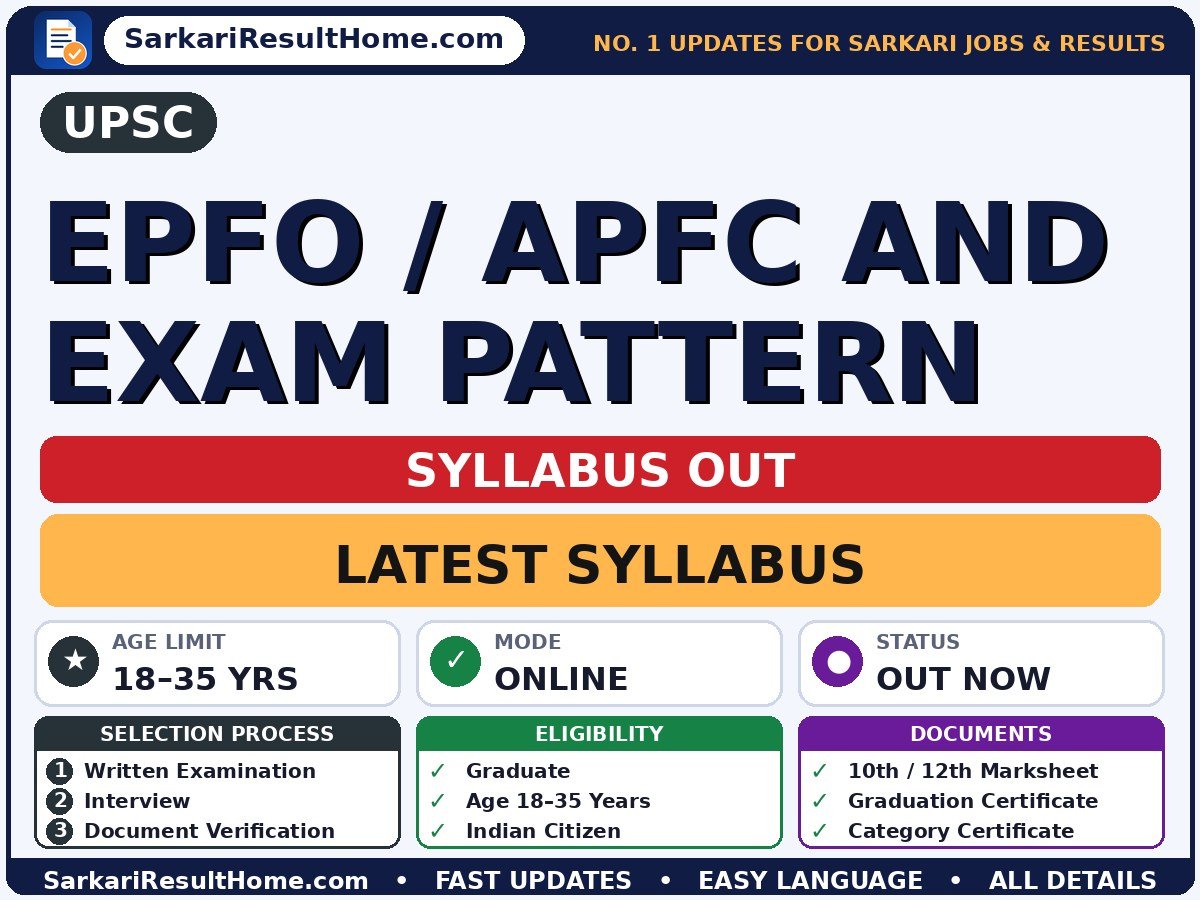
UPSC EPFO / APFC and Exam Pattern Syllabus 2026 & Exam Pattern
Written by Ketan on 05 Oct 2026 · Organisation: Union Public Service Commission · State: All India
The EPFO / APFC and Exam Pattern syllabus of Union Public Service Commission (UPSC) is available on its official website. The official syllabus PDF is given in the Important Links table. Here is a simple guide to what to read and how to plan.
The stages are Written Examination, Interview, Document Verification, Medical Examination. The direct links are in the Important Links table below.
You can also see more UPSC updates on the UPSC Recruitment page, all syllabus and the home page.
UPSC EPFO / APFC and Exam Pattern Syllabus 2026: Exam Date & Pattern
| Important Dates | Key Details |
|---|---|
|
|
| Application Fee |
|---|
Payment mode: Online – Debit Card, Credit Card, Net Banking, IMPS, Mobile Wallet / Cash Card |
| General | EWS | OBC | SC | ST | Total |
|---|---|---|---|---|---|
| 29 | 8 | 18 | 15 | 10 | 80 |
UPSC EPFO / APFC and Exam Pattern Selection Process & Exam Details
The stages, in the order they usually take place:
- Written Examination
- Interview
- Document Verification
- Medical Examination
How the Syllabus Shapes Your Preparation
The syllabus usually comes with the notification or soon after. Check its date, because boards sometimes change the pattern between two exams.
For EPFO / APFC and Exam Pattern the stages are Written Examination, Interview, Document Verification and Medical Examination. Keep preparing for the later rounds while the earlier one is still running.
Post-wise Eligibility at a Glance
Post-wise qualification level, subject requirement and minimum marks, where the notice states them:
| Post | Minimum level | Subject needed | Marks needed |
|---|---|---|---|
| Enforcement Officer / Accounts Officer | Graduate | — | — |
| Assistant Provident Fund Commissioner | Graduate | — | — |
Preparation Plan From the Dates
- Selection runs through: Written Examination → Interview → Document Verification → Medical Examination. Prepare for the later stage while the first is still pending, because gaps between stages are usually short.
- Track negative marking rules in the notice and practise attempting only questions you are reasonably sure of.
- Read the exam pattern once fully so you know the sections, marks and duration before you begin.
How to Prepare for UPSC EPFO / APFC and Exam Pattern
- 1
Get the official syllabus
Download it from upsc.gov.in so you study the correct version.
- 2
Break it into topics
Write every subject and topic as a checklist.
- 3
Rank by weight
Give more time to high-mark sections shown in the exam pattern.
- 4
Solve previous papers
They show the real difficulty and repeated topics.
- 5
Revise weekly
Keep one day a week for revision and a timed mock test.
About the UPSC EPFO / APFC and Exam Pattern Syllabus
UPSC has made the syllabus and exam pattern of EPFO / APFC and Exam Pattern available, and this page explains how to use it.
Keep the official syllabus PDF open while you read this page; the link is in the Important Links table. If our summary and the syllabus ever differ, the syllabus is right.
UPSC EPFO / APFC and Exam Pattern and Syllabus at a Glance
The stages mentioned for this exam are: Written Examination → Interview → Document Verification → Medical Examination. This is how the notice describes the selection.
Use the subject groups below only as a map. The topics, marks and timing of this exam are decided by the notice.
Subject-wise Preparation for EPFO / APFC and Exam Pattern
Exams like this usually test the areas below. Check the marks and the number of questions for each in the official notice.
- Language and comprehension: Reading and grammar at the level asked in the notice.
- Numerical ability and reasoning: Class 10 level mathematics and reasoning questions.
- General studies: History, geography, polity, science and current affairs.
- Subject paper: If the notice mentions a subject paper, give it the largest share of your time.
How to Turn the Official Syllabus into a Study Plan
- Download the latest syllabus PDF from the official link and save it on your phone
- Copy every topic into a notebook or a sheet, one line per topic, with a column for done, revised and tested
- Mark the topics that have appeared often in the previous papers, and study them first
- Check the marking scheme, especially negative marking and sectional time limits, and practise with the same rules
- Re-read the syllabus every month; organisations sometimes revise it between two notices
A Weekly Study Plan for EPFO / APFC and Exam Pattern
Keep the plan simple: new topics on weekdays, tests and revision on the weekend.
A simple pattern works for most students: study three hours of new topics, one hour of practice questions and half an hour of revision of the earlier day. Increase the time only when this feels easy.
Previous Year Papers and Mock Tests
Old papers tell you the real level of the exam and the way questions are asked. Solve at least the last three years under the real time limit.
A mock test is useful only when you analyse it. The analysis takes longer than the test and is worth it.
Common Mistakes While Preparing
- Collecting many books and finishing none. One standard book per subject and the previous papers are enough to begin
- Studying from an old syllabus. Check the year and the exam name on the PDF you use
- Leaving current affairs for the last month. Read a little every week
- Ignoring the exam pattern. Sectional time limits and negative marking change the way you attempt questions
- Depending on videos only and not writing or solving anything yourself
More UPSC Updates
Other notices of UPSC, such as admit cards, Sarkari Results and answer keys, are on the UPSC page. All syllabus pages are in the syllabus list.
About UPSC
The Union Public Service Commission is the constitutional body that selects officers for the civil services of the Union. Its roots go back to the Public Service Commission of 1926; after Independence it was given constitutional status and began working as UPSC on 26 January 1950. Its office is at Dholpur House, Shahjahan Road, New Delhi.
Read more on the UPSC company page or visit the official website at upsc.gov.in.
Earlier UPSC Notifications
Earlier UPSC notifications we have tracked, for comparison. Tap a title to open it, or see all UPSC updates.
| Update | Type | Posts | Key date |
|---|---|---|---|
| UPSC CAPF AC PET / PST and Exam Pattern Syllabus 2026 & Exam Pattern | Syllabus | 349 | 12 Mar 2026 |
| UPSC NDA II Answer Key 2026 Released | Answer Key | 394 | 11 Jun 2026 |
| UPSC Civil Services IFS Mains Admit Card 2026 Out: How to Download | Admit Card | 1013 | 22 Nov 2026 |
| UPSC NDA II Admit Card 2026 – Download Link | Admit Card | 394 | 11 Jun 2026 |
| UPSC CDS II Admit Card 2026 – Download Link | Admit Card | 451 | 11 Jun 2026 |
| UPSC CPF Assistant Commandant CAPF Final Marks Sarkari Result 2026: Direct Link & Score Card | Sarkari Result | 357 | 03 Aug 2025 |
Study Tips for This Syllabus
- Give more time to sections carrying more marks in the exam pattern.
- Schedule a weekly revision day and a weekly mock.
- Note the negative marking scheme and sectional time limits.
- Track your accuracy per topic, not just your total score.
- Prepare short notes and formulas for last-week revision.
UPSC EPFO / APFC and Exam Pattern Syllabus: Important Links
| Link | Open |
|---|---|
| Official notification — PDF | Click Here |
| Check Official Notification | Click Here |
| Apply Online Link | Click Here |
| Official Website — Open | Click Here |
| Make sure to complete the application before the deadline — 14 September 2026. | Click Here |
| All UPSC updates | Open UPSC Recruitment |
| UPSC latest jobs | View jobs |
| UPSC admit cards | View admit cards |
| UPSC Sarkari Results | View results |
UPSC EPFO / APFC and Exam Pattern Syllabus: Frequently Asked Questions
What is the official website for UPSC EPFO / APFC and Exam Pattern?
The official website is upsc.gov.in.
Where can I get the UPSC EPFO / APFC and Exam Pattern syllabus?
You can get it from the official notification on the official website (upsc.gov.in).
Is the official syllabus PDF the final word?
Yes. Our page explains how to use it, but the topics, marks and exam pattern are those given in the official PDF.
Can I prepare from an old syllabus?
Only as a starting point. Check the year and the exam name on the PDF and compare it with the latest notice before you rely on it.
Where can I get the latest Sarkari Result updates of UPSC?
SarkariResultHome.com posts every new update of UPSC as soon as it is published. Bookmark the site and open it directly to see the newest jobs, admit cards, Sarkari Results and answer keys.
Source and Credit
This post is written from the syllabus and exam pattern notice that Union Public Service Commission released on its official website upsc.gov.in (see also the notice here). We have put the information in our own words and layout. The official website is the final word, so please check it before you apply, pay a fee or travel.
Come back to SarkariResultHome.com for the next Sarkari Result and job update of UPSC. Save sarkariresulthome.com as a bookmark and open it directly; the latest Sarkari Result, admit cards and sarkari naukri posts are always on the first page.
Browse More Govt Jobs by Category
About SarkariResultHome.com
SarkariResultHome.com is a free website that brings government job news in one place for students and job seekers across India. We publish new recruitment notices, admit cards, results, answer keys, syllabus and admission forms, and we explain each one in simple English with the important dates, fee, age limit, vacancy and direct links to the official websites. Every post is written in our own words after reading the official notice, so you can save time and apply with confidence.
Disclaimer
SarkariResultHome.com is not a government website and is not connected with any government department, board or recruiting body. We try our best to keep every detail correct, but mistakes can happen. Before you apply or pay any fee, please read the official notification on the organisation's own website. We are not responsible for any loss caused by using the information on this page. We never take money for a job, so please do not trust anyone who asks for it.
SarkariResultHome.com is an independent information website. Notices, names and logos belong to the respective organisations.