 SarkariResultHome.com
SSC Selection Post Phase 14 Syllabus 2026 & Exam Pattern
Written by Sujata on 09 Oct 2026 · Organisation: Staff Selection Commission · State: All India
The Selection Post Phase 14 syllabus of Staff Selection Commission (SSC) is available on its official website. Here is a simple guide to what to read and how to plan.
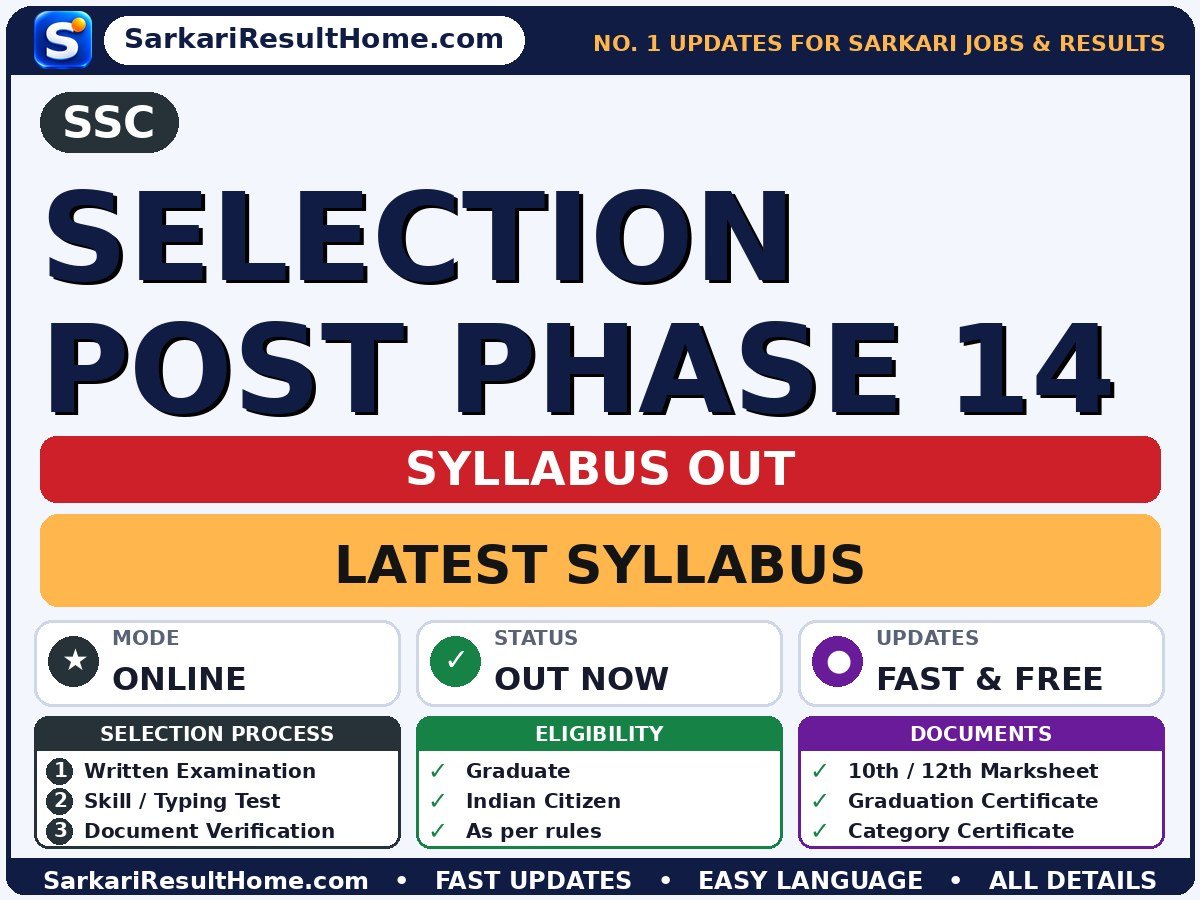
The stages are Written Examination, Skill / Typing Test, Document Verification. The direct links are in the Important Links table below.
You can also see more SSC updates on the SSC Recruitment page, all syllabus and the home page.
SSC Selection Post Phase 14 Syllabus 2026: Exam Date & Pattern
| Important Dates | Key Details |
|---|---|
|
|
SSC Selection Post Phase 14 Selection Process & Exam Details
The stages, in the order they usually take place:
- Written Examination
- Skill / Typing Test
- Document Verification
How the Syllabus Shapes Your Preparation
A good plan starts from the syllabus: list the topics, note which carry more marks and give each a target date. Previous year papers will then show you how those topics are asked.
For Selection Post Phase 14 the stages are Written Examination, Skill / Typing Test and Document Verification. Keep preparing for the later rounds while the earlier one is still running.
Preparation Plan From the Dates
- Selection runs through: Written Examination → Skill / Typing Test → Document Verification. Prepare for the later stage while the first is still pending, because gaps between stages are usually short.
- Solve at least three previous papers of this exam under a timer to learn the real difficulty.
- Keep a running list of questions you got wrong and re-attempt it every weekend.
How to Prepare for SSC Selection Post Phase 14
- 1
Get the official syllabus
Download it from ssc.gov.in so you study the correct version.
- 2
Break it into topics
Write every subject and topic as a checklist.
- 3
Rank by weight
Give more time to high-mark sections shown in the exam pattern.
- 4
Solve previous papers
They show the real difficulty and repeated topics.
- 5
Revise weekly
Keep one day a week for revision and a timed mock test.
About the SSC Selection Post Phase 14 Syllabus
SSC has made the syllabus and exam pattern of Selection Post Phase 14 available, and this page explains how to use it.
Open the official syllabus on ssc.gov.in before you do anything else.
SSC Selection Post Phase 14 Exam Pattern and Syllabus at a Glance
The stages mentioned for this exam are: Written Examination → Skill / Typing Test → Document Verification. This is how the notice describes the selection.
SSC Selection Post Phase 14 Exam Pattern 2026
Before you study, look at the pattern of Selection Post Phase 14: the stages, the subjects, the marks and the time of each part. It decides how you divide your hours.
In short: negative marking: 0.50 marks.
Paper details
| Part | Subject | No. of Questions/Max Marks | Time Duration |
|---|---|---|---|
| A | General Intelligence | 25/50 | 15 Mins |
| B | General Awareness | 25/50 | 15 Mins |
| C | Quantitative Aptitude (Basic Arithmetic Skill) | 25/50 | 15 Mins |
| D | English Language (Basic Knowledge) | 25/50 | 15 Mins |
| Total | 100 Qs / 200 Marks | 60 Mins |
SSC Selection Post Phase 14 Syllabus 2026: Subject-wise Topics
Subject-wise topics for Selection Post Phase 14: start with the subject that carries the most marks in the pattern above.
| Subject | Topics |
|---|---|
| Matric Level General Intelligence & Reasoning | Non-verbal type questions, Similarities and differences, Space visualization, Problem-solving, analysis, Judgment, decision making, Visual memory, Discriminating observation, Relationship concepts, Figure classification, Arithmetical number series, non-verbal series |
| Matric Level Quantitative Aptitude | Number Systems, Decimals and Fractions and Relationship Between Numbers, Fundamental arithmetical operation, Computation of Whole Numbers, Averages, Interest, Percentages, Ratio and Proportion, Profit and Loss, Discount, Mensuration, Time and Distance, Ratio and Time, Time and Work, Use of Tables and Graphs |
| Matric Level General Awareness | Sports, History and Culture, Geography, Economic scene, General Polity, including the Indian Constitution, Scientific Research, General awareness of the environment and its application to society |
| Matric Level English Language | Basics of the English Language, Vocabulary, Grammar, Synonyms, Sentence Structure, Antonyms and its correct usage |
| 12th Level General Intelligence & Reasoning | Both verbal and Non-verbal questions, Semantic Analogy, Symbolic operations, Symbolic/Number Analogy, Trend, Figural Analogy, Space orientation, Semantic classification, Venn Diagram, Symbolic/Number Classification, Drawing inferences, Figural Classification, Semantic Series, Figural Pattern – folding and completion, Number Series, Embedded figures, Figural Series, Critical Thinking, Problem Solving, Emotional Intelligence, Word Building, Social Intelligence, Coding and Decoding |
| 12th Level General Awareness | General awareness of the environment and its application to society, Sports, History and Culture, Geography, Economic scene, General Polity, including the Indian Constitution, Scientific Research etc |
| 12th Level Quantitative Aptitude | Arithmetic, Number Systems, Computation of Whole Number, Decimal and Fractions, Relationship between numbers: Fundamental arithmetical operations, Percentages, Ratio and Proportion, Square roots, Averages, Interest (Simple and Compound), Profit and Loss, Discount, Partnership Business, Mixture and Allegation, Time and distance, Time and work |
| 12th Level English Language | Spot the Error, Fill in the Blanks, Synonyms/ Homonyms, Antonyms, Spellings/ Detecting Misspelt words, Idioms & Phrases, One-word substitution, Improvement of Sentences, Active/ Passive Voice of Verbs, Conversion into Direct/ Indirect narration, Shuffling of Sentence parts, Shuffling of Sentences in a passage, Cloze Passage Comprehension Passage |
| Graduation Level Quantitative Aptitude | Computation of whole numbers, Decimals, Fractions and relationships between numbers, Percentage, Ratio & Proportion, Square roots, Averages, Interest, Profit and Loss, Discount, Partnership Business, Mixture and Allegation, Time and distance, Time & Work, Circle and its chords, tangents, Angles subtended by chords of a circle, common tangents to two or more circles, Triangle, Quadrilaterals, Regular Polygons, Circle, Right Prism, Right Circular Cone, Basic algebraic identities of School Algebra & Elementary surds, Graphs of Linear Equations, Triangle and its various kinds of centres, Congruence and similarity of triangles, Right Circular Cylinder, Sphere, Hemispheres, Rectangular Parallelepiped, Regular Right Pyramid with triangular or square base, Trigonometric ratio, Degree and Radian Measures, Standard Identities |
| Graduation Level General Intelligence and Reasoning | Both verbal and non-verbal questions, Analogies, Space visualization, Spatial orientation, Judgment and decision-making, Visual memory, Discrimination and Observation, Relationship concepts, Arithmetical reasoning and figural classification, Arithmetic number series, Non-verbal series, Coding and decoding, Statement conclusion, Syllogistic reasoning, Semantic Analogy, Symbolic/Number Analogy, Figural Analogy, Semantic Classification, Symbolic/ Number Classification, Figural Classification, Semantic Series, Number Series, Figural Series, Problem-Solving, Word Building, Coding & decoding, Numerical Operations, Symbolic Operations, Trends, Space Orientation and Visualisation |
| Graduation Level General Awareness | General awareness of the environment and its application to society, Sports, History and Culture, Geography, Economic scene, General Polity, including the Indian Constitution, Scientific Research, etc |
How to Turn the Official Syllabus into a Study Plan
- Download the latest syllabus PDF from the official link and save it on your phone
- Copy every topic into a notebook or a sheet, one line per topic, with a column for done, revised and tested
- Mark the topics that have appeared often in the previous papers, and study them first
- Check the marking scheme, especially negative marking and sectional time limits, and practise with the same rules
- Re-read the syllabus every month; organisations sometimes revise it between two notices
A Weekly Study Plan for Selection Post Phase 14
Keep the plan simple: new topics on weekdays, tests and revision on the weekend.
A simple pattern works for most students: study three hours of new topics, one hour of practice questions and half an hour of revision of the earlier day. Increase the time only when this feels easy.
Previous Year Papers and Mock Tests
Previous papers are the best free guide. Solve them in one sitting, then spend more time on the mistakes than on the score.
Keep an error notebook. A weekly look at it removes most repeated mistakes.
Common Mistakes While Preparing
- Collecting many books and finishing none. One standard book per subject and the previous papers are enough to begin
- Studying from an old syllabus. Check the year and the exam name on the PDF you use
- Leaving current affairs for the last month. Read a little every week
- Ignoring the exam pattern. Sectional time limits and negative marking change the way you attempt questions
- Depending on videos only and not writing or solving anything yourself
More SSC Updates
Other notices of SSC, such as admit cards, Sarkari Results and answer keys, are on the SSC page. All syllabus pages are in the syllabus list.
How SSC selects candidates
Most SSC exams follow a computer-based tier system. Tier 1 is a qualifying objective test, Tier 2 is a deeper objective paper, and depending on the post a descriptive paper, skill or typing test, physical standard and endurance tests and document verification follow. Marks in each stage are added as per the notice, and final selection depends on the merit list and the preferences you fill.
Read more on the SSC company page or visit the official website at ssc.gov.in.
Earlier SSC Notifications
Earlier SSC notifications we have tracked, for comparison. Tap a title to open it, or see all SSC updates.
| Update | Type | Posts | Key date |
|---|---|---|---|
| SSC Selection Post Phase 14 Syllabus 2026 & Exam Pattern | Syllabus | — | 15 Oct 2026 |
| SSC Stenographer Grade C and D Syllabus 2026: Topic-wise Details | Syllabus | — | 09 Sep 2026 |
| SSC CHSL Exam Typing Test Preparation Guide Syllabus 2026 & Exam Pattern | Syllabus | — | 12 Oct 2026 |
| SSC GD Maths Topic-wise Weightage Expert Preparation Guide Syllabus 2026: Topic-wise Details | Syllabus | — | 12 Oct 2026 |
| SSC CPO Sectional Timing Details Syllabus 2026: Topic-wise Details | Syllabus | — | 12 Oct 2026 |
Study Tips for This Syllabus
- Use only the current-year syllabus; older ones may have dropped topics.
- Solve previous papers alongside each topic to see how questions are framed.
- Study current affairs regularly if the pattern includes a general awareness section.
- Cover the qualifying papers too; failing them ends the process.
- Track your accuracy per topic, not just your total score.
SSC Selection Post Phase 14: Question Papers and Answer Keys
These are the papers of the SSC Selection Post Phase 14 exam that we have saved for you: 1 answer key file. Download them, attempt them like a real test and note which topics cost you marks.
| Paper / key | Open |
|---|---|
| Answer key — Check Answer Key Notice (16 Sep 2026) | Download PDF |
Tip: attempt the paper in one sitting, mark the questions you guessed, and revise those topics first.
SSC Selection Post Phase 14 Syllabus: Important Links
| Link | Open |
|---|---|
| Official website | ssc.gov.in |
| All SSC updates | Open SSC Recruitment |
| SSC latest jobs | View jobs |
| SSC admit cards | View admit cards |
| SSC results | View results |
Complete SSC Exam Timeline
Every stage of this Sarkari Naukri we have covered, from application to Sarkari Result:
| Stage | Post | Key date |
|---|---|---|
| Syllabus | SSC Selection Post Phase 14 Syllabus 2026 & Exam Pattern | — |
| Answer Key | SSC Selection Phase 14 Answer Key 2026 Out – Download PDF | 09 Oct 2026 |
SSC Selection Post Phase 14 Syllabus: Frequently Asked Questions
Where can I get the SSC Selection Post Phase 14 syllabus?
You can get it from the official notification on the official website (ssc.gov.in).
What is the official website for SSC Selection Post Phase 14?
The official website is ssc.gov.in.
Is the official syllabus PDF the final word?
Yes. Our page explains how to use it, but the topics, marks and exam pattern are those given in the official PDF.
Can I prepare from an old syllabus?
Only as a starting point. Check the year and the exam name on the PDF and compare it with the latest notice before you rely on it.
Is there negative marking in the Selection Post Phase 14 exam?
As per the facts we have, negative marking: 0.50 marks. Confirm it in the official notice before the exam.
What is the exam pattern of Selection Post Phase 14?
The stage-wise pattern with the subjects, questions, marks and time is given in the exam pattern tables on this page.
Where can I get the latest Sarkari Result updates of SSC?
SarkariResultHome.com posts every new update of SSC as soon as it is published. Bookmark the site and open it directly to see the newest jobs, admit cards, Sarkari Results and answer keys.
Source and Credit
Credit for the original information goes to Staff Selection Commission, whose syllabus and exam pattern notice we used on its official website ssc.gov.in. We have put the information in our own words and layout. The official website is the final word, so please check it before you apply, pay a fee or travel.
Come back to SarkariResultHome.com for the next Sarkari Result and job update of SSC. Save sarkariresulthome.com as a bookmark and open it directly; the latest Sarkari Result, admit cards and sarkari naukri posts are always on the first page.
Browse More Govt Jobs by Category
About SarkariResultHome.com
SarkariResultHome.com is a free website that brings government job news in one place for students and job seekers across India. We publish new recruitment notices, admit cards, results, answer keys, syllabus and admission forms, and we explain each one in simple English with the important dates, fee, age limit, vacancy and direct links to the official websites. Every post is written in our own words after reading the official notice, so you can save time and apply with confidence.
Disclaimer
SarkariResultHome.com is not a government website and is not connected with any government department, board or recruiting body. We try our best to keep every detail correct, but mistakes can happen. Before you apply or pay any fee, please read the official notification on the organisation's own website. We are not responsible for any loss caused by using the information on this page. We never take money for a job, so please do not trust anyone who asks for it.
SarkariResultHome.com is an independent information website. Notices, names and logos belong to the respective organisations.